
Inclusive, justice-shaped worship resources for the Revised Common Lectionary – prayers, liturgy, creative ideas and accessible reflections that connect scripture with everyday life.
The Readings at a Glance
Exodus 12:1–4 [5–10] 11–14
On the eve of liberation, God gives the people a meal to remember – practical, urgent, and full of meaning. This is not faith as abstraction, but faith lived in the midst of danger and change, with a ritual that will help future generations remember that God hears the cry of the oppressed and makes a way towards freedom.
Psalm 116:1–2, 12–19
A psalm of gratitude for God’s care and deliverance. It asks how we can respond to such love, and answers not with grand achievement but with thanksgiving, prayer, and a life turned again towards God in trust.
1 Corinthians 11:23–26
Paul recalls the meal Jesus shared with his disciples, giving bread and cup as signs of his self-giving love. Each time the church shares this meal, it remembers not only what Jesus said and did, but the kind of community his love creates – shaped by grace, remembrance, and shared belonging.
John 13:1–17, 31b–35
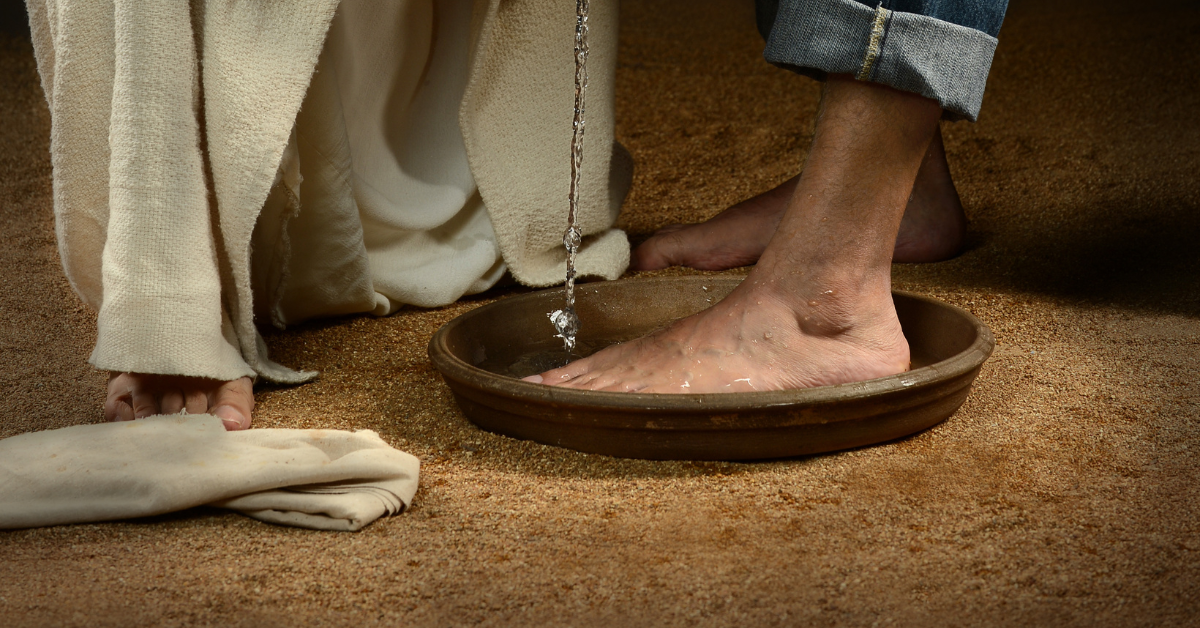
Jesus kneels to wash his disciples’ feet, turning power upside down and showing that love takes the form of service. Then he gives a new commandment: to love one another as he has loved them. In this reading, holiness is found not in status or display, but in humility, tenderness, and love made visible.
Prayers and Liturgy
Choose the sections that are appropriate to your context and tradition. For example, if communion is part of a longer service, it may be more appropriate to use only parts of the liturgy.
Gathering at the table
We come to the table where love takes bread,
pours a cup,
and kneels with a towel.
We come to the table of Christ, who loves us to the end.
Here, love makes itself plain in shared food and humble care.
Teach us to receive this love, and to offer it to one another.
This is Christ’s table.
Not a reward for the worthy,
but bread for the hungry.
Not a prize for the certain,
but grace for those who come as they are.
We come with gratitude and need, with tenderness and fear.
We come for mercy, for belonging, for love that becomes action.
The Peace
Peace is not distance from one another –
it is love made visible in how we draw near.
The peace of Christ be with you.
And also with you.
(Share peace in ways that honour boundaries – words, a nod, a wave, a hand on heart.)
The Great Thanksgiving
The Spirit is here.
The Spirit is with us.
Lift up your hearts.
We lift them to the God of love.
Let us give thanks to the Holy One.
It is right to give thanks and praise.
It is right, and a faithful thing,
to give you thanks, God of liberation and love.
You hear the cries of the oppressed.
You remember your people in bondage.
You make a way towards freedom,
and you call us to remember with our bodies,
with our tables,
with our lives.
You give bread for the journey.
You gather your people into covenant.
You teach us that salvation is not private escape,
but a people shaped for justice, mercy, and shared life.
In Jesus, you came among us with love that could be touched –
in bread broken,
in wine poured,
in feet washed,
in friendship given,
in a new commandment spoken.
He did not cling to status.
He laid aside the signs of power.
He knelt before those he loved.
He showed us that glory looks like service,
and that love takes flesh in what we do for one another.
And so, with angels and ancestors,
with all who hunger for freedom and belonging,
with all who serve and are served in tenderness,
we sing the song of heaven:
Holy, holy, holy One,
breath of all that lives, fire of all that loves,
heaven and earth are full of your glory.
Hosanna in the highest.
Blessed is the One who comes to heal and to set free.
Hosanna in the highest.
Thanksgiving and story
Blessed are you, Holy One.
In Jesus you gave us love we could touch.
At supper with his friends,
on a night shadowed by betrayal and fear,
Jesus took bread and gave thanks.
He took the cup and shared it.
He gave himself as food for the life of the world.
Then he rose from the table,
wrapped a towel around himself,
and washed their feet.
He chose the posture of a servant,
not because they were worth less,
but because love refuses hierarchy.
He gave them a commandment both simple and costly:
love one another.
Not in theory only.
Not in words alone.
But in acts of care,
in shared bread,
in humility,
in staying near when the night grows dark.
This is the mystery we hold here –
that love kneels,
that mercy feeds,
that dignity is honoured in mutual care,
and that Christ is still present
where people make room for one another.
Words of Institution
On the night before he gave himself for us,
Jesus took bread;
he gave thanks, broke it, and said:
“Take, eat. This is my body, given for you.
Do this in remembrance of me.”
When the meal was ended,
he took the cup;
he gave thanks, and said:
“Drink from this, all of you.
This is my blood of the new covenant,
poured out for you and for many,
for the forgiveness of sins.
Do this, as often as you drink it,
in remembrance of me.”
Christ has died.
Christ is risen.
Christ will come again.
Prayer of the Spirit
Pour out your Spirit on us gathered here,
and on these gifts of bread and cup.
Make them for us the body and blood of Christ,
that we may be for the world the body of Christ:
humble in love,
gentle in strength,
faithful in service,
steadfast in mercy.
Where pride keeps us apart, draw us closer.
Where fear makes us guarded, teach us trust.
Where power is used to diminish, make us protectors of dignity.
Where love is needed in practical form, make us ready.
Give us grace to receive care without shame.
Give us courage to offer care without control.
Shape us into a people who wash feet in whatever form love requires –
through kindness,
through repair,
through shared bread,
through patient presence,
through justice that honours every body.
Through Christ, with Christ, in Christ,
in the unity of the Holy Spirit,
all honour and glory are yours,
God of promise and presence,
now and always.
Amen.
The Prayer Jesus taught
As Jesus taught us, we pray:
(Use your community’s preferred wording/version.)
Breaking the bread
We break this bread
to share in the body of Christ.
Though we are many, we are one body,
because we all share in one bread.
The gifts of God for the people of God.
Thanks be to God.
Sharing the bread and cup
(Words such as these may be used during the distribution.)
Given in love – for you.
Grace for the journey.
(If people receive a blessing instead of the elements: “May Christ be close to you; may love hold you.”)
Prayer after Communion
God of table and towel,
we thank you for meeting us at this table.
You have fed us with grace,
and drawn us deeper into love.
When service feels costly, keep us gentle.
When love asks more of us than comfort allows, keep us faithful.
Send us out from here
to love one another in real and practical ways,
to honour dignity,
to share what we have,
to stay near in the hard hours,
and to practise mercy without display.
God of steadfast love,
now and forever. Amen.
Sending
Go in peace – not because the way is simple,
but because love has knelt among us.
We will share bread. We will stay near. We will love one another.